Currently Empty: R0.00
How to Choose the Best Reverse Osmosis System in South Africa
Finding the Best Reverse Osmosis System South Africa has to offer can be overwhelming. With hundreds of systems available online, it can be difficult to know which one is right for your home, business or industrial application. While many suppliers claim their system is the best, the reality is that the right reverse osmosis system depends on your water quality, daily water demand and intended application.
Choosing the best reverse osmosis system in South Africa isn’t about buying the biggest or the cheapest unit—it’s about selecting a professionally designed system that delivers reliable performance, consistent water quality and long-term value.
At Puritech, every recommendation starts with a recent professional laboratory water analysis. By understanding exactly what is in your water, we can recommend a reverse osmosis system that is engineered for your specific requirements rather than relying on assumptions.
What Is a Reverse Osmosis System?
A reverse osmosis (RO) system is one of the most advanced water purification technologies available today.
It uses pressure to force water through a semi-permeable membrane that separates clean water from dissolved contaminants.
Depending on the quality of the incoming water, a reverse osmosis system can significantly reduce the following:
- Total Dissolved Solids (TDS)
- Calcium
- Magnesium
- Sodium
- Fluoride
- Nitrates
- Sulphates
- Chlorides
- Many heavy metals
- Various dissolved impurities
The result is clean, high-quality water suitable for drinking, food production, commercial processes and industrial applications.
Why Not All Reverse Osmosis Systems Are the Same
One of the biggest mistakes buyers make is assuming that every reverse osmosis system performs the same.
Two systems may appear similar on paper, but the differences in quality can be significant.
Factors such as membrane quality, pump performance, filtration stages, pressure control, and engineering design all influence how well a system performs over time.
A low-cost system may save money initially, but poor performance, frequent breakdowns and higher maintenance costs often make it more expensive in the long run.
What Makes the Best Reverse Osmosis System?
The best reverse osmosis system in South Africa should offer more than just purified water.
It should provide:
- Reliable performance.
- High-quality components.
- Efficient water recovery.
- Low operating costs.
- Easy maintenance.
- Readily available replacement parts.
- Professional technical support.
- Long service life.
A professionally engineered system delivers consistent performance year after year.
Start With Your Water Source
Before choosing any reverse osmosis system, you need to understand where your water comes from.
Common water sources include:
- Municipal water.
- Borehole water.
- River water.
- Dam water.
- Process water.
- Rainwater.
Each source has unique water characteristics.
For example:
Municipal water may require relatively simple pretreatment.
Borehole water often requires additional treatment for hardness, iron or manganese.
Industrial process water may need extensive pretreatment before reaching the RO membranes.
Why Water Analysis Comes First
This is the single most important step when selecting the best reverse osmosis system in South Africa.
A professional laboratory water analysis identifies:
- Water hardness.
- Total Dissolved Solids (TDS).
- Iron.
- Manganese.
- Sodium.
- Fluoride.
- Nitrates.
- Sulphates.
- Chlorides.
- pH.
- Microbiological quality where required.
Without this information, choosing an RO system becomes guesswork.
An incorrectly specified system may experience the following:
- Poor water quality.
- Frequent membrane replacement.
- High maintenance costs.
- Reduced production capacity.
- Premature equipment failure.
Understand Your Daily Water Demand
Choosing the right system also depends on how much purified water you need.
Ask yourself:
- How many people will use the water?
- Is it for drinking only?
- Is it for a business?
- Is it for food production?
- Will it supply a water shop?
- Is it for industrial manufacturing?
The answers determine the required production capacity.
Installing a system that is too small often results in insufficient water production.
Installing one that is too large increases unnecessary costs.
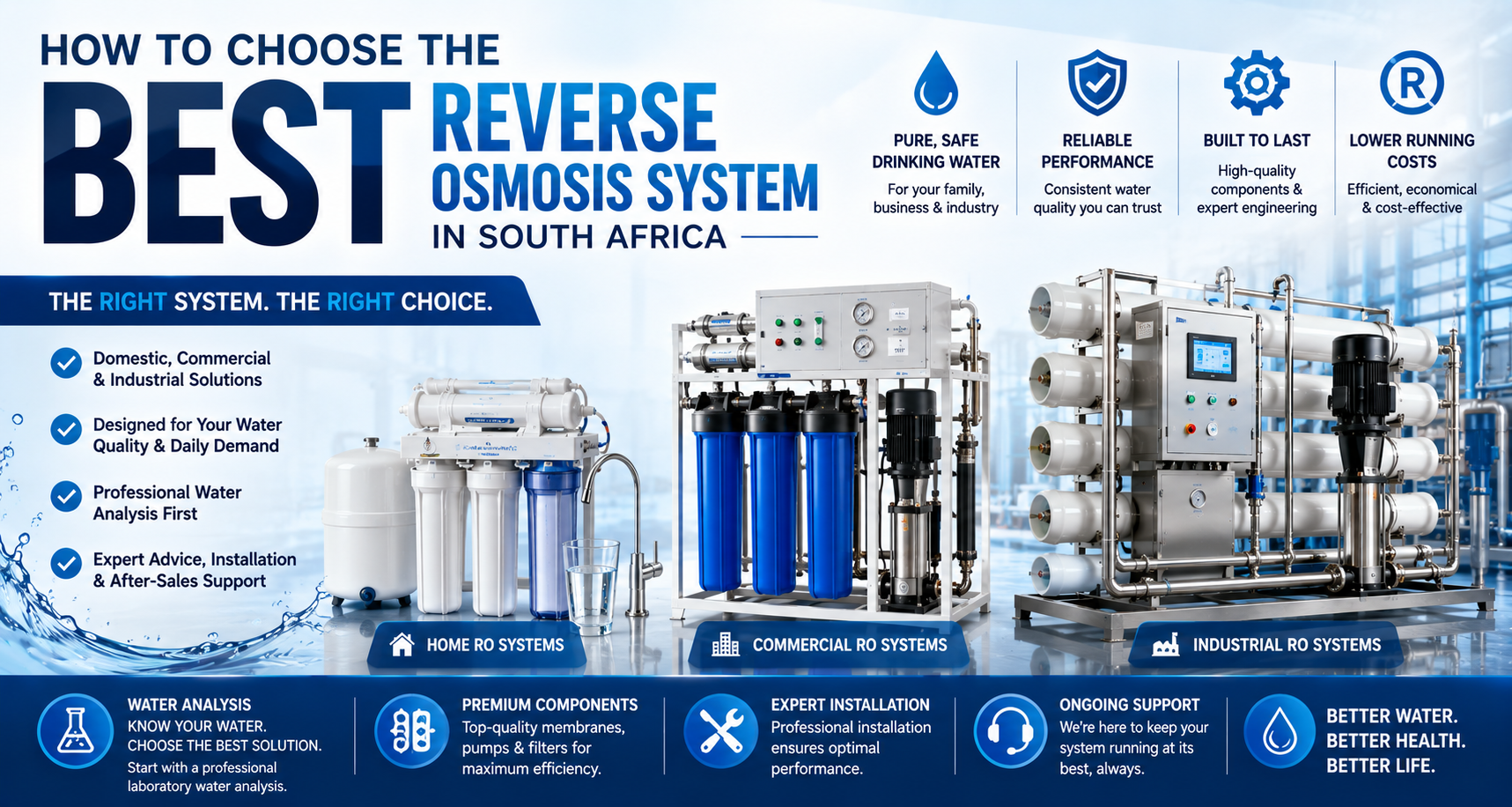
Home, Commercial or Industrial?
Reverse osmosis systems are available in many sizes.
Home Reverse Osmosis Systems
Ideal for:
- Drinking water.
- Small households.
- Apartments.
- Offices.
Typically installed under the kitchen sink.
Commercial Reverse Osmosis Systems
Suitable for:
- Restaurants.
- Coffee shops.
- Hotels.
- Schools.
- Medical practices.
- Water refill businesses.
Designed for higher daily demand.
Industrial Reverse Osmosis Systems
Engineered for:
- Manufacturing.
- Food processing.
- Pharmaceutical production.
- Large-scale water treatment.
- Industrial process water.
These systems require detailed engineering and professional commissioning.
Avoid Buying on Price Alone
Price is important—but it should never be the only deciding factor.
A cheaper system may use:
- Lower-quality membranes.
- Inferior pumps.
- Smaller pressure vessels.
- Lower-grade fittings.
- Limited filtration stages.
- Inadequate controls.
These compromises often lead to:
- Higher operating costs.
- More frequent repairs.
- Reduced membrane life.
- Poor water quality.
The best reverse osmosis system in South Africa is one that delivers dependable performance and long-term value—not simply the lowest purchase price.
Think About the Future
Your water needs may change over time.
Perhaps your family grows.
Your business expands.
Your production increases.
Choosing a system with some room for future growth can reduce upgrade costs later.
A professionally designed RO system should meet both your current and anticipated requirements.
Common Buying Mistakes
Many buyers make avoidable mistakes, including:
- Purchasing without a water analysis.
- Choosing the cheapest system available.
- Ignoring maintenance requirements.
- Buying a system that is too small.
- Buying a system that is too large.
- Assuming all RO membranes are identical.
- Overlooking after-sales support.
- Ignoring spare parts availability.
Avoiding these mistakes saves money and improves long-term reliability.
Why Professional Design Matters
A reverse osmosis system is more than just a membrane.
It is a complete treatment process that may include:
- Sediment filtration.
- Activated carbon filtration.
- Water softening.
- Chemical dosing.
- High-pressure pumps.
- Reverse osmosis membranes.
- Storage tanks.
- UV sterilisation where required.
Each component must work together to achieve reliable performance.
This is why professionally engineered systems consistently outperform generic, off-the-shelf solutions.
How to Compare Reverse Osmosis Systems
Once you’ve confirmed that reverse osmosis is the right solution for your water, the next step is choosing the right system.
When comparing the best reverse osmosis systems in South Africa, many buyers focus only on price or production capacity. While these are important, they don’t tell the whole story.
The quality of the components, engineering, after-sales support, and maintenance requirements all have a significant impact on long-term performance.
Let’s look at the most important factors to compare before making your investment.
Domestic vs Commercial vs Industrial Reverse Osmosis Systems
Not every RO system is built for the same application.
Choosing a system that matches your daily water demand is essential.
Domestic Reverse Osmosis Systems
Designed for:
- Homes
- Apartments
- Offices
- Small businesses
Typical features include the following:
- Compact under-sink installation.
- Point-of-use drinking water.
- Multi-stage filtration.
- Low daily water production.
- Easy maintenance.
These systems are ideal for improving the quality of drinking and cooking water.
Commercial Reverse Osmosis Systems
Commercial systems are designed for higher daily water demand.
Typical applications include the following:
- Restaurants.
- Coffee shops.
- Hotels.
- Schools.
- Medical clinics.
- Water refill businesses.
- Small manufacturing facilities.
Commercial RO systems generally include:
- Higher flow rates.
- Larger membrane housings.
- High-pressure pumps.
- Larger storage tanks.
- Automatic controls.
Industrial Reverse Osmosis Systems
Industrial RO systems are engineered for continuous, high-volume operation.
Applications include:
- Food and beverage manufacturing.
- Pharmaceutical production.
- Mining.
- Agriculture.
- Chemical processing.
- Bottled water production.
- Industrial process water.
These systems often incorporate:
- Multiple membrane vessels.
- Advanced monitoring systems.
- Automated flushing.
- PLC controls.
- Chemical dosing systems.
- Custom pretreatment.
Industrial systems should always be professionally designed and commissioned.
Membrane Quality Matters
The membrane is the heart of every reverse osmosis system.
It performs the critical task of separating purified water from dissolved contaminants.
High-quality membranes typically provide:
- Better contaminant rejection.
- Higher production efficiency.
- Longer lifespan.
- Improved reliability.
- Lower operating costs.
Inferior membranes may:
- Require frequent replacement.
- Produce inconsistent water quality.
- Increase maintenance costs.
- Reduce production capacity.
When comparing systems, ask which membrane brand is being used and whether replacement membranes are readily available in South Africa.
Pump Quality
The high-pressure pump drives water through the RO membrane.
Its quality has a direct impact on:
- Water production.
- System efficiency.
- Energy consumption.
- Operating pressure.
- Long-term reliability.
Premium pumps are designed for continuous operation and typically offer better performance and longer service life than low-cost alternatives.
Recovery Rate
‘Recovery rate’ refers to the percentage of incoming water converted into purified water.
For example:
If 100 litres enter the system and 60 litres become purified water, the recovery rate is 60%.
Recovery rates vary depending on:
- Feed water quality.
- System design.
- Membrane type.
- Pretreatment.
Higher recovery rates can improve water efficiency, but pushing recovery too high without proper engineering can shorten membrane life.
The best balance depends on your specific water conditions.
The Importance of Pretreatment
One of the biggest factors affecting RO performance is pretreatment.
Pretreatment protects the membranes from damage and extends their lifespan.
Depending on your water quality, pretreatment may include the following:
- Sediment filtration.
- Activated carbon filtration.
- Water softening.
- Iron and manganese removal.
- Chemical dosing.
- UV sterilisation.
Skipping pretreatment may lead to the following:
- Membrane fouling.
- Reduced production.
- Poor water quality.
- Increased maintenance.
- Premature membrane failure.
A professionally designed system always includes the pretreatment stages required for your specific water source.
Storage Tanks
Purified water must often be stored before use.
Storage capacity depends on:
- Daily water demand.
- Peak usage periods.
- Production rate.
- Available space.
A correctly sized storage tank ensures a consistent supply of purified water, even during periods of high demand.
Automatic Controls
Modern reverse osmosis systems often include intelligent control features.
These may include:
- Automatic start and stop.
- Low-pressure protection.
- High-pressure protection.
- Automatic flushing.
- Dry-run protection.
- Water level control.
- Digital monitoring.
- Alarm notifications.
These features improve reliability while reducing operator involvement.
Maintenance Requirements
Every reverse osmosis system requires routine maintenance.
Typical servicing includes the following:
- Replacing sediment filters.
- Replacing activated carbon filters.
- Inspecting pumps.
- Monitoring operating pressure.
- Checking water quality.
- Sanitising the system.
- Replacing membranes when necessary.
Regular maintenance protects your investment and helps ensure consistent water quality.
Running Costs
The purchase price is only part of the overall investment.
You should also consider ongoing costs such as the following:
- Replacement filters.
- Membrane replacement.
- Electricity.
- Water consumption.
- Servicing.
- Spare parts.
A professionally engineered system often has a lower total cost of ownership, even if the initial purchase price is higher.
Spare Parts Availability
One question many buyers forget to ask is the following:
Can replacement parts be sourced locally?
Reliable suppliers should offer:
- Replacement membranes.
- Pumps.
- Filters.
- Pressure gauges.
- Valves.
- Fittings.
- Technical support.
Choosing equipment with readily available spare parts reduces downtime and protects your investment.
Technical Support Matters
Even the best reverse osmosis system requires occasional servicing and technical assistance.
Before purchasing, ask whether the supplier offers:
- Installation.
- Commissioning.
- Preventative maintenance.
- Technical support.
- Emergency repairs.
- Replacement components.
- Water quality testing.
Strong after-sales support is often the difference between years of reliable operation and costly downtime.
Real-World Example
A food processing company initially purchased a low-cost imported RO system based solely on price.
Within 18 months, they experienced:
- Frequent pump failures.
- Poor water quality.
- Difficulty sourcing replacement membranes.
- Extended production downtime.
Puritech conducted a full assessment of the site’s water quality and production requirements before designing a commercial reverse osmosis system with the correct pretreatment, premium components and local after-sales support.
The result was:
- Consistent water quality.
- Improved production efficiency.
- Reduced maintenance costs.
- Reliable access to spare parts.
- Greater long-term value.
The cheapest option became the most expensive, while the professionally engineered solution delivered dependable performance.
Compare the Total Value—Not Just the Price
When evaluating the best reverse osmosis system in South Africa, consider the following:
- System quality.
- Engineering design.
- Component reliability.
- Water recovery.
- Energy efficiency.
- Maintenance requirements.
- Technical support.
- Spare parts availability.
- Long-term operating costs.
A reverse osmosis system is a long-term investment. Choosing quality from the beginning often results in lower costs and better performance over its lifetime.
Choosing the Right Reverse Osmosis Supplier
Finding the Best Reverse Osmosis System South Africa offers is only half the decision. Choosing the right supplier is equally important.
A high-quality reverse osmosis system should provide years of dependable service. However, even the best equipment requires professional design, correct installation and ongoing maintenance.
When evaluating suppliers, look beyond the product brochure. Consider their technical expertise, support and commitment to long-term customer success.
Why Engineering Expertise Matters
Reverse osmosis is not a one-size-fits-all solution.
Every installation should be designed according to:
- Water source.
- Laboratory water analysis.
- Daily water demand.
- Peak flow requirements.
- Available water pressure.
- Available installation space.
- Future expansion plans.
An experienced supplier will evaluate these factors before recommending a system.
Engineering-first design helps ensure:
- Reliable performance.
- Lower operating costs.
- Longer membrane life.
- Better water quality.
- Greater energy efficiency.
The Risks of Buying on Price Alone
A low purchase price can be attractive, but it often comes with compromises.
Cheap imported systems may include:
- Lower-grade membranes.
- Undersized pumps.
- Limited pretreatment.
- Inferior fittings.
- Minimal quality control.
- Little or no technical support.
These systems may initially appear to save money, but frequent breakdowns, costly repairs and poor water quality can quickly outweigh the initial savings.
Investing in quality equipment from a trusted supplier is often the most cost-effective decision over the life of the system.
Questions to Ask Before Buying
Before investing in any reverse osmosis system, ask your supplier the following questions:
Has my water been professionally analysed?
A recent laboratory water analysis ensures the system is designed for your specific water quality.
Is the system correctly sized?
An undersized system may not meet demand, while an oversized system increases unnecessary costs.
What quality membranes are used?
Ask about:
- Membrane manufacturer.
- Expected lifespan.
- Replacement availability.
- Performance specifications.
What pretreatment is included?
Proper pretreatment protects the RO membranes and improves system performance.
Are spare parts readily available?
Replacement parts should be easily obtainable in South Africa to minimise downtime.
What warranty is provided?
Understand:
- Warranty period.
- Coverage.
- Conditions.
- Service requirements.
Is technical support available?
Ask whether the supplier provides:
- Installation.
- Commissioning.
- Preventative maintenance.
- Emergency repairs.
- Ongoing technical assistance.
The Importance of Preventative Maintenance
Regular maintenance protects both performance and investment.
A preventative maintenance programme typically includes:
- Filter replacement.
- Membrane inspection.
- Pressure testing.
- Water quality monitoring.
- Pump servicing.
- System sanitisation.
- Performance optimisation.
Routine servicing often prevents costly failures before they occur.
Why Local Support Makes a Difference
Water treatment systems are long-term investments.
Working with a South African supplier provides important advantages, including:
- Faster response times.
- Local technical expertise.
- Easier access to spare parts.
- On-site servicing.
- Better understanding of South African water conditions.
These benefits reduce downtime and improve the long-term reliability of your system.
Real-Life Case Study 1 – Residential Customer
A homeowner in Cape Town wanted to improve the taste of their municipal drinking water.
After reviewing a recent laboratory water analysis, Puritech recommended a compact under-sink reverse osmosis system with activated carbon pretreatment.
The result:
- Fresh, great-tasting drinking water.
- Reduced chlorine taste and odour.
- Reliable daily performance.
- Simple maintenance.
Instead of purchasing the largest system available, the customer invested in the right-sized solution for their needs.
Real-Life Case Study 2 – Commercial Customer
A growing bottled water business required a higher-capacity purification system.
Their existing imported RO unit struggled to meet demand, and spare parts were difficult to source.
Puritech conducted a detailed assessment of the following:
- Feed water quality.
- Daily production requirements.
- Future expansion plans.
A custom-designed commercial reverse osmosis system was installed with:
- Premium membranes.
- High-pressure pumps.
- Appropriate pretreatment.
- Automatic controls.
- Preventative maintenance support.
The outcome included the following:
- Increased production capacity.
- Consistent water quality.
- Reduced downtime.
- Lower maintenance costs.
- Reliable local technical support.
Frequently Asked Questions
What is the best reverse osmosis system South Africa offers?
The best reverse osmosis system is the one that matches your water quality, water demand, and application. A professional laboratory water analysis is the best starting point.
Is reverse osmosis suitable for municipal water?
Yes.
Many homeowners use reverse osmosis to improve the taste, clarity and overall quality of municipal drinking water.
Can reverse osmosis treat borehole water?
Yes, but borehole water often requires additional pretreatment depending on the laboratory water analysis.
Pretreatment may include the following:
- Sediment filtration.
- Water softening.
- Iron and manganese removal.
- Activated carbon filtration.
How long does an RO membrane last?
Membrane lifespan depends on:
- Feed water quality.
- Pretreatment.
- Maintenance.
- Daily usage.
With proper care, membranes can provide several years of reliable service.
How often should filters be replaced?
Replacement intervals vary depending on water quality and usage.
Routine servicing by a qualified technician helps maintain optimal performance.
Is reverse osmosis expensive to maintain?
When professionally designed and properly maintained, operating costs are generally predictable.
Regular maintenance is far less expensive than repairing damage caused by neglected servicing.
Why Puritech Is the Right Choice
At Puritech, we believe every successful water treatment project begins with understanding the water.
Rather than recommending generic systems, we:
- Review recent laboratory water analysis reports.
- Assess your daily water requirements.
- Design customised reverse osmosis solutions.
- Supply high-quality equipment.
- Provide professional installation.
- Offer preventative maintenance.
- Deliver ongoing technical support.
Whether you need a compact domestic system or a large industrial installation, our goal is to provide a reliable solution that delivers long-term performance and value.
Final Thoughts
Choosing the best reverse osmosis system South Africa has available is about much more than selecting the most powerful or least expensive unit. The ideal system is one that is professionally designed around your specific water quality, daily demand and long-term requirements.
A quality reverse osmosis system should deliver consistent performance, dependable operation and excellent water quality while remaining cost-effective to maintain. Equally important is choosing a supplier who offers technical expertise, local support and reliable after-sales service.
At Puritech, every recommendation starts with a recent professional laboratory water analysis. This allows us to engineer reverse osmosis systems that solve real water challenges, protect your investment and provide years of dependable service.
If you’re looking for the best reverse osmosis system South Africa can offer, start with understanding your water—and let experienced professionals design the right solution for your home, business, or industrial application.